

es un país transcontinental situado en el suroeste de Europa y en el norte de África. Además de ocupar la mayor parte de la península ibérica, España está formada por dos archipiélagos (el de las islas Canarias en el océano Atlántico y el de las islas Baleares en el mar Mediterráneo) y dos ciudades autónomas (Ceuta y Melilla) en el norte de África, aparte de varias islas menores en esta zona y otras cercanas a la península, como el peñón de Vélez de la Gomera, el peñón de Alhucemas, las islas Chafarinas y la isla del Perejil. España limita al oeste con el océano Atlántico y Portugal; al norte con el mar Cantábrico, al noreste con Francia y Andorra, al otro lado de la cordillera de los Pirineos; al este con el mar Mediterráneo y al sur con Marruecos, en las fronteras de Ceuta y de Melilla en el continente africano.
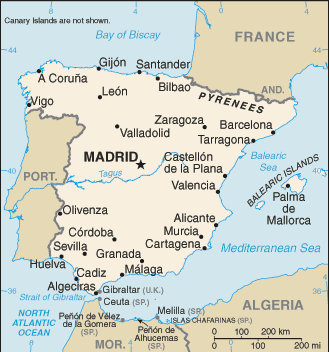
Country’s geographic divisions (Communities, cities etc.)
Spain and its autonomous communities are divided into fifty provinces (Spanish: provincias, IPA: [pɾoˈβinθjas]; sing. provincia).[note 1] Spain’s provincial system was recognized in its 1978 constitution but its origin dates back to 1833. Ceuta, Melilla and the Plazas de soberanía are not part of any provinces.
Province name | Capital | Autonomous community | Lists of municipalities |
A Coruña (Galician); La Coruña (Spanish); Corunna (English, archaic) | A Coruña (Galician); La Coruña (Spanish); Corunna (English, archaic) | ||
Vitoria-Gasteiz; Gasteiz (Basque); Vitoria (Spanish) | |||
Balearic Islands; Illes Balears (Catalan); Islas Baleares (Spanish) | |||
Castellón de la Plana; Castelló de la Plana (Valencian) | |||
Córdoba; Cordova (English, archaic) | |||
San Sebastián (Spanish); Donostia (Basque) | |||
Lleida (Catalan); Lérida (Spanish) | |||
Navarre; Nafarroa (Basque); Navarra (Spanish) | Pamplona; Iruña (Basque) | ||
Ourense (Galician); Orense (Spanish) | |||
Seville; Sevilla (Spanish) | Seville; Sevilla (Spanish) | ||
Zaragoza; Saragossa (English) | Zaragoza; Saragossa (English) |
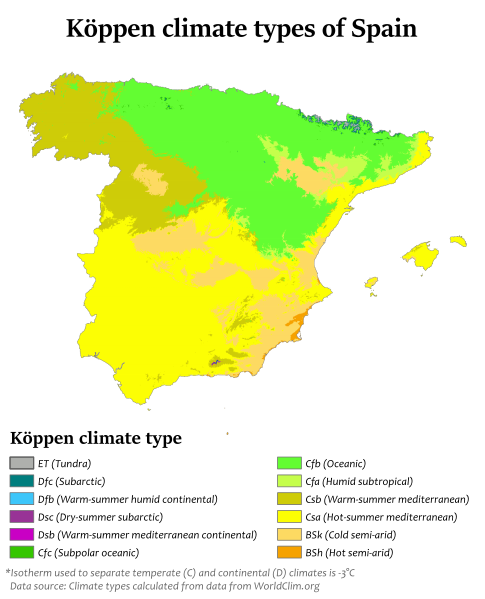
The climate in Spain varies across the country. Spain is the most climatically diverse country in Europe with 13 different Köppen climates, excluding the Canary Islands, and is within the 10 most climatically type countries in the world. Five main climatic zones can be distinguished, according to Guzman geographical situation and orographic conditions:
Apart from the five main climate zones, other noticeable sub-zones can be found, such as the humid subtropical climate in large areas in the northern half of Catalonia going down to Barcelona, the province of Huesca and northern Navarre. The dry continental climates all across Spain in the highest areas (notably in the Sierra Nevada and the highest areas in central-northern Spain), the alpine climate and the Subarctic climate in the higher areas of northern Spain’s various mountain ranges (notably the Cantabrian Mountains and the Pyrenees), a tropical climate in the coastal areas of the Canary Islands and a hot desert climate in the Southeastern coastline and eastern parts of the Canary Islands, notably around Almeria and Las Palmas
As of 1 January 2019, Spain had a total population of 47,007,367, which represents a 0.59% increase since 2018 The CIA Factbook (2011) gives a racial description of “composite of Mediterranean and Nordic types” under “ethnic groups” instead of the usual breakdown of ethnic composition. This reflects the formation of the modern Kingdom of Spain by the accretion of several independent Iberian realms, like León, Castile, Navarre, the Crown of Aragon, and Granada, among others.
Spain’s population peaked in 2012, at 46,818,216 people. Spain’s official population fell by 206,000 to 47.1 million, mostly because of immigrants returning home due to the effects of the European economic and fiscal crisis. Its population density, at 91.4 inhabitants per square kilometre (237/sq mi), is lower than that of most Western European countries. With the exception of the capital Madrid, the most densely populated areas lie around the coast.
The population of Spain doubled during the twentieth century, but the pattern of growth was extremely uneven due to large-scale internal migration from the rural interior to the industrial cities, a phenomenon which happened later than in other Western European countries. No fewer than eleven of Spain’s fifty provinces saw an absolute decline in population over the century.
The last quarter of the century saw a dramatic fall in birth rates. Spain’s fertility rate of 1.47 (the number of children the average woman will have during her lifetime) is lower than the EU average but has climbed every year since the late 1990s. The birth rate has climbed in 10 years from 9.10 births per 1000 people per year in 1996 to 10.9 in 2006.
Spain has no official religion. The Spanish Constitution of 1978 abolished the Roman Catholic Church as the official state religion, while recognizing the role it plays in Spanish society. As of 2018[update], 68.5% of the population define themselves as Catholic, 26.4% as non-believers or atheists, and 2.6% other religions. Among believers, 59% assert they almost never go to any religious service, by contrast, 16.3% attend one or more religious service almost every week. Practical secularization is strong¡ and most, especially those of the younger generations, ignore the religious doctrines on issues such as pre-marital sex, sexual orientation or contraception.
Immigration and Demographic Issues
Main article: Immigration to Spain
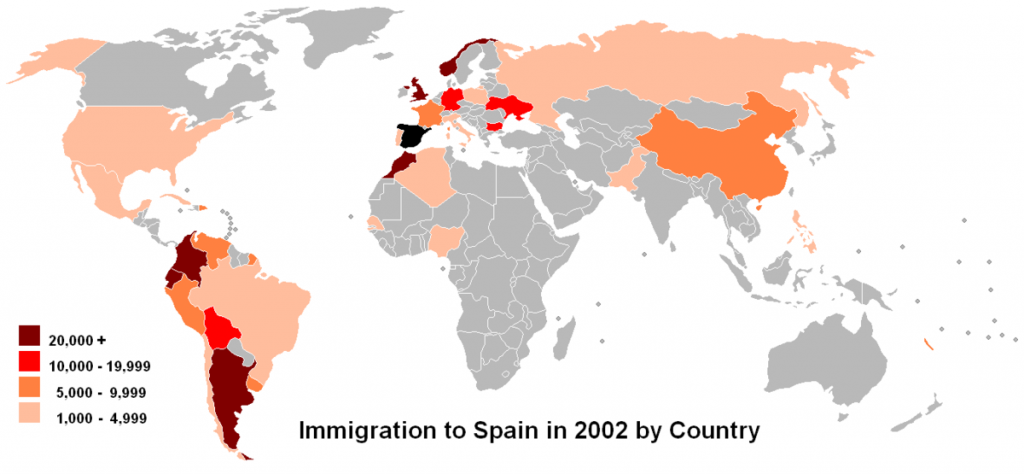
Immigration to Spain in 2002 by country.
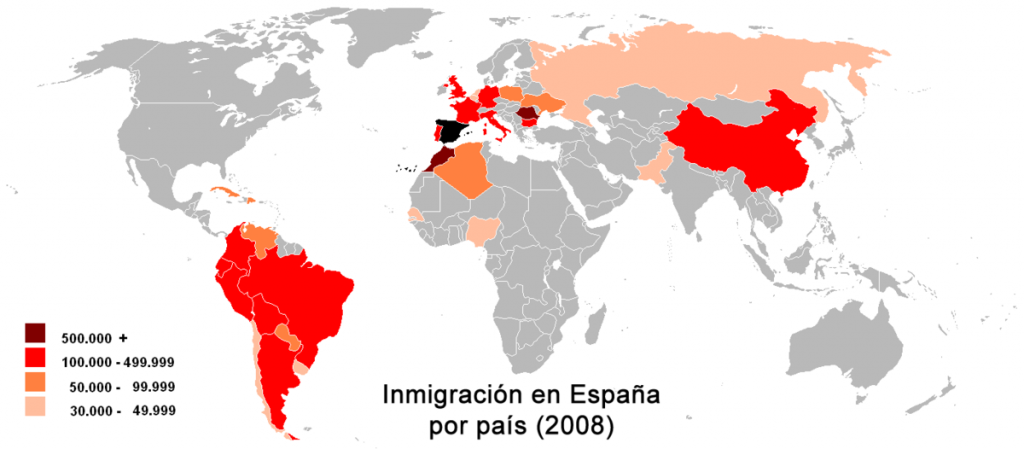
Immigration to Spain in 2008 by country.
The population of Spain doubled during the twentieth century as a result of the spectacular demographic boom in the 1960s and early 1970s. After that time, the birth rate plunged through the 1980s and Spain’s population became stalled, its demographics showing one of the lowest sub replacement fertility rates in the world, only above Greece, Portugal, Hungary, Ukraine, and Japan.
Many demographers have linked Spain’s very low fertility rate to the country’s lack of any real family planning policy. Spain spends the least on family support out of all western European countries—0.5% of GDP. A graphic illustration of the enormous social gulf in this field is the fact[that a Spanish family would need to have 57 children to enjoy the same financial support as a family with 3 children in Luxembourg.
In terms of emigration vs. immigration, after centuries of net emigration, Spain, has recently experienced large-scale immigration for the first time in modern history. According to the Spanish government there were 5,730,667 foreign residents in Spain as of January 2011. Of these, more than 860,000 were Romanian, and half 760,000 were Moroccan while the number of Ecuadorians was around 390,000. Colombian population amounted to around 300,000. There are also a significant number of British (359,076 as of 2011, but more than one million are estimated to live permanently in Spain) and German (195,842) citizens, mainly in Alicante, Málaga provinces, Balearic Islands and Canary Islands. Chinese number over 166,000. Immigrants from several sub-Saharan African countries have also settled in Spain as contract workers, although they represent only 4.08% of all the foreign residents in the country.
During the early 2000s, the mean year-on-year demographic growth set a new record with its 2003 peak variation of 2.1%, doubling the previous record reached back in the 1960s when a mean year-on-year growth of 1% was experienced. In 2005 alone, the immigrant population of Spain increased by 700,000 people.
The arrival of migrating young adults was the main reason for the slight increase in Spain’s fertility rate. From 2002 through 2008 the Spanish population grew by 8%, of which 7% were foreign.