

Hellas (or Greece), (Ελλάδα, Ellada), officially the Hellenic Republic (Ελληνική Δημοκρατία, Elliniki Dimokratia) is a Parliamentary Republic.
The President of the Republic, is elected by Parliament every 5 years, is Head of State.
General elections are normally held every 4 years unless the Parliament is dissolved earlier. The electorate consists of all Greek citizens who are 17 years of age.
The Prime Minister is Head of Government.
The Ministerial Council, consisting of the Prime Minister, Ministers, Deputy Ministers and Ministers without portfolio, is the collective decision-making body that constitutes the Government of Greece.
The State is structured by the Constitution (Σύνταγμα Sýntagma).
The Constitution of Hellas is the fundamental Charter of the State. It includes the main rules concerning the structure of the State, the exercise of its powers by the authorities as well as a list of human rights.
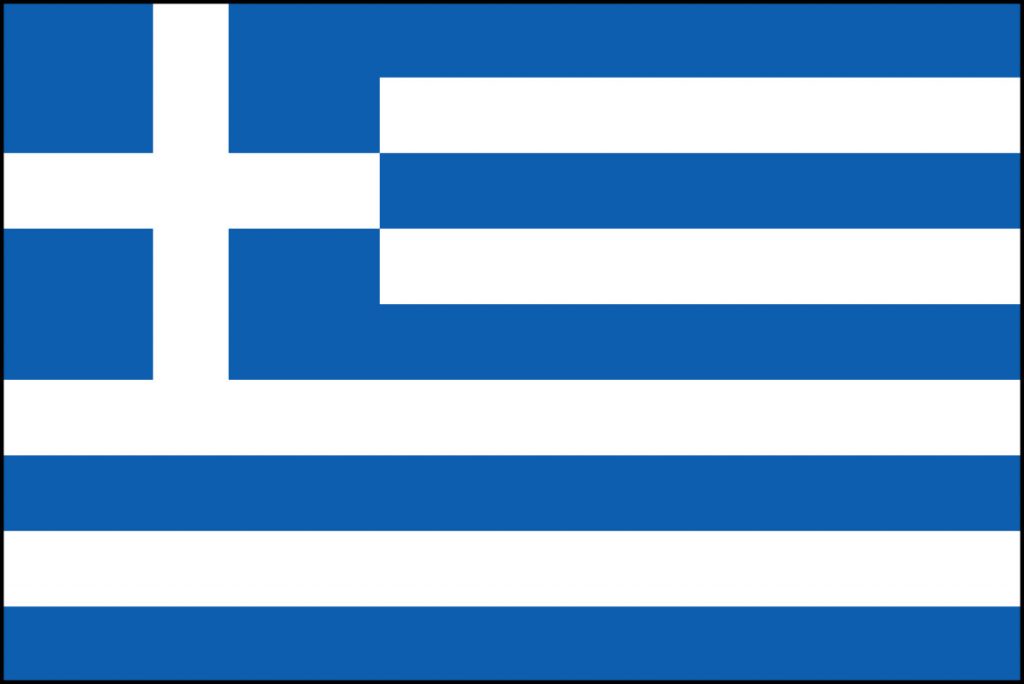
The national flag of Greece consists of nine horizontal stripes of equal width, five blue and four white, alternately, the first and last stripes being blue. The upper left corner contains a blue square, along the five stripes with a white cross inside it. The flag is hung on a white flagstaff at the top of which there is a white cross.
The national emblem of Greece consists of a blue escutcheon with a white cross totally surrounded by two laurel branches.
The emblem is painted or woven, mainly on the hats, uniforms and buttons of the military, the security forces etc.
The Greek national emblem was provided for by the Constitution of Epidauros of 1 January 1822 and established by decree on 15 March of the same year. It was blue and white and circular in shape.
The National Anthem of Greece consists of the first two verses of the poem “Hymn to Freedom”, written in May 1823 in Zakynthos by the poet Dionysios Solomos. A year later it was published in Mesolonghi and the same year Fauriel included it in a collection of Greek folk songs. In 1828 Nicholas Mantzaros, a Corfiot musician and friend of Solomos’ set the poem to music, based on a folk theme, intended for a four-voice male choir rather than preserving it’s character of march. After that the “Hymn to Freedom” was regularly heard on national holidays.
The President of the Republic http://www.presidency.gr/en/homepage/
The President is elected by the Parliament for a 5-year term, with a maximum of two terms. Upon expiration of the presidential term, the Parliament votes to elect a new President.
Executive power
The Cabinet, which consists of members of the Government, includes the Prime Minister and all the Ministers which are appointed by the President of the Republic on the proposal of the Prime Minister.
Legislative power https://www.hellenicparliament.gr/en/
The members of the Greek Parliament are elected by universal suffrage of all citizens over the age of 17. It has 300 members, elected for a 4-year term by a system of reinforced proportional representation in 48 multi-seat constituencies, 8 single-seat constituencies and a single nationwide list. 288 of the 300 Members of the Parliament are elected directly by the people, as citizens can declare their preference by marking their name on the ballot. The remaining 12 seats are elected by nationwide party lists on a top-down basis and based on the proportion of the total vote received by each party in the election.
Judiciary power
The judiciary power in Greece is distinguished into administrative, civil (municipal) and penal courts.
In Greek justice there are three supreme courts:
• the Council of State
• the Court of Cassation
• the Chamber of Accounts
These courts consist of judges who have graduated from the National School of Judges. The presidents and vice-presidents of the three supreme courts are chosen by the Cabinet among the serving members of each Supreme Court.
Administrative divisions of the country (Regional governance, Local Authorities etc.)
The administrative divisions of Hellas consist of 2 main levels: the municipalities and the regions. In addition, AT 3rd level, a number of decentralized administrations overseeing the regions exist as part of the Ministry of the Interior, but are not entities of local government.
Municipalities
The 1st level of government is constituted by the 325 municipalities (δήμοι, dími; sing. δήμος, dímos). They are run by a mayor (δήμαρχος, dímarchos) and a municipal council (δημοτικό συμβούλιο, dimotikó simvúlio), elected every 5 years. The municipalities are further subdivided into municipal units (δημοτικές ενότητες, dimotikés enótites) and finally into communities (κοινότητες, kinótites). Although communities have their own councils, their role is purely advisory to the municipal-level government.
Regions
The 2nd level is composed of the 13 regions (περιφέρειες, periféries; sing. περιφέρεια, periféria), run by a regional governor (περιφερειάρχης, periferiárchis) and a regional council (περιφερειακό συμβούλιο, periferiakó simvúlio), popularly elected every 5 years.
The regions are divided into 74 regional units (περιφερειακές ενότητες, periferiakés enótites), usually but not always coterminous with the former prefectures. Each regional unit is headed by a vice-regional governor (αντιπεριφερειάρχης, antiperiferiárchis).
Each color corresponds to a region. By black line are divided the regional units (except Attica), with white lines, the municipalities (except Athens and Thessaloniki agglomerations)
Decentralized Administrations